


VA loans are assumable, so a buyer can take over your 2-3% pre-COVID rate. Here's how it works, the pros and cons, and how to bridge the sale price vs. loan balance gap.

And so here's something most homeowners with a VA loan don't realize they're sitting on: if you bought your house before COVID and locked in a rate somewhere in the 2s or 3s, you don't have to lose that rate just because you sell. VA loans are assumable. That means a buyer can literally step into your existing mortgage — same rate, same remaining term, same payment — instead of going out and getting a brand new loan at whatever rate the market's charging today.
With rates sitting up around 6.5% to 7% right now, that's not a small thing. That's the difference between a house being affordable to a buyer and not. For a seller, it can be the reason your house gets an offer instead of sitting on the market. This is a real lever to pull in a market where a lot of buyers are priced out, and honestly, most real estate agents don't even bring it up because most of them have never done one.
Now, it's not all upside — there's a real wrinkle in the middle of this, and it's the same wrinkle every time: what happens when your house is worth a lot more than what's left on the loan? We'll get to that, because it's the part that trips people up and it's also the part that has a fix. Let's walk through the whole thing.
The other part people get wrong is thinking this is some kind of handshake deal between buyer and seller. It's not. The loan servicer — whoever you send your mortgage payment to — runs the whole show, and the buyer still has to qualify.
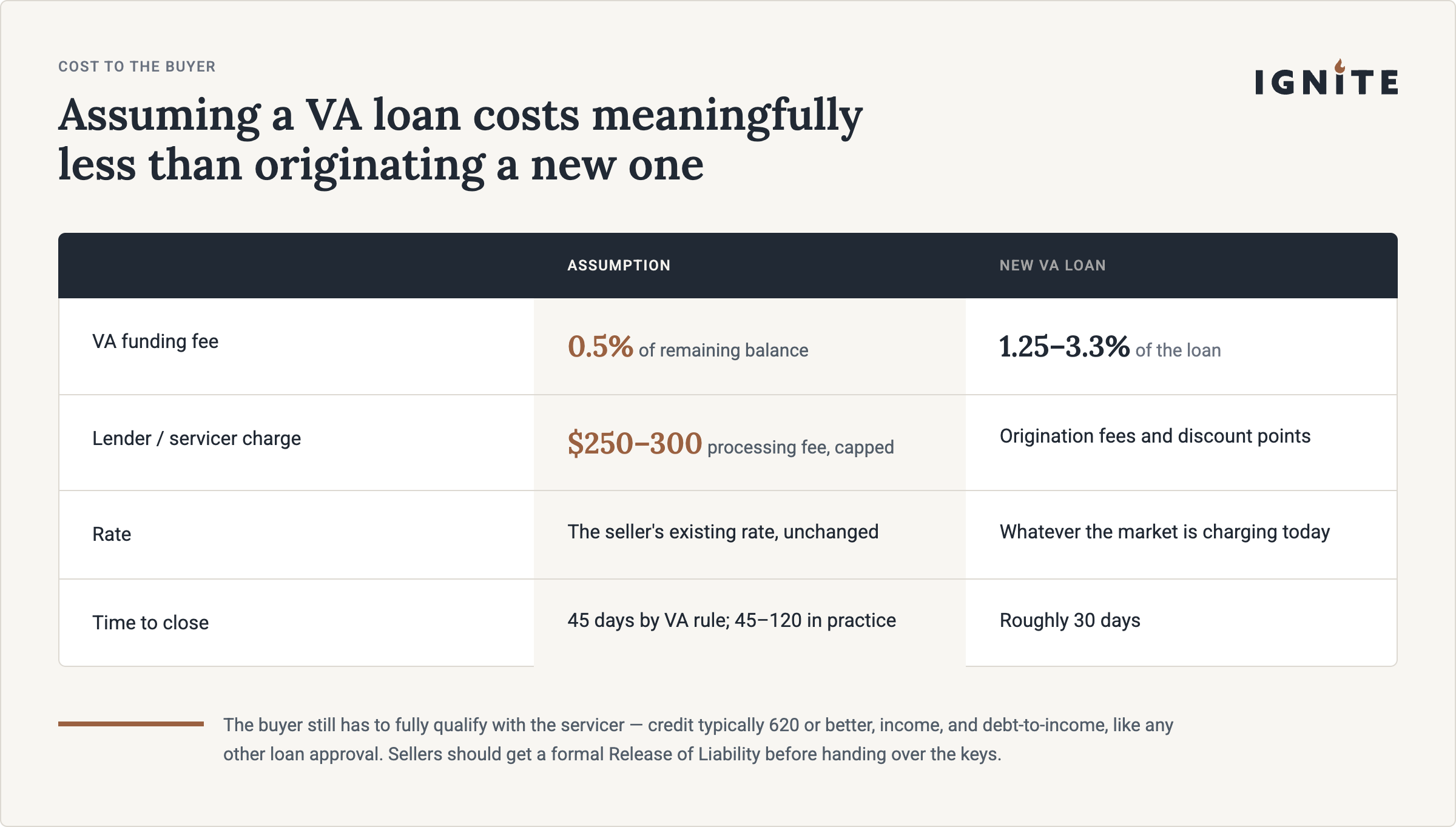
Here's roughly how it goes. The buyer applies with your servicer, not a new lender, and gets underwritten just like they would for a new loan — credit (typically 620 or better), income, debt-to-income, the whole file. VA loans can be assumed by veterans and non-veterans alike; you don't have to be military to take one over, you just have to qualify. The buyer pays a VA funding fee, but it's a small one for an assumption — about 0.5% of the remaining loan balance, versus the 1.25% to 3.3% funding fee on a brand new VA loan. The servicer can also charge a modest processing fee, capped around $250 to $300.
The catch is time. VA rules say the servicer has 45 days to process it, but in the real world it's running more like 45 to 120 days depending on how backed up that servicer is and how clean the paperwork is. That's a lot longer than a normal 30-day close, so this isn't the move if you need to be out of the house next month.
One more piece that matters a lot: as the seller, you want a document called a Release of Liability before you hand over the keys. Without it, you can still be on the hook if the new buyer stops paying down the road. Don't skip this step. Any lender or attorney doing this the right way will build it in, but it's worth asking about directly rather than assuming — no pun intended — it's automatically included.
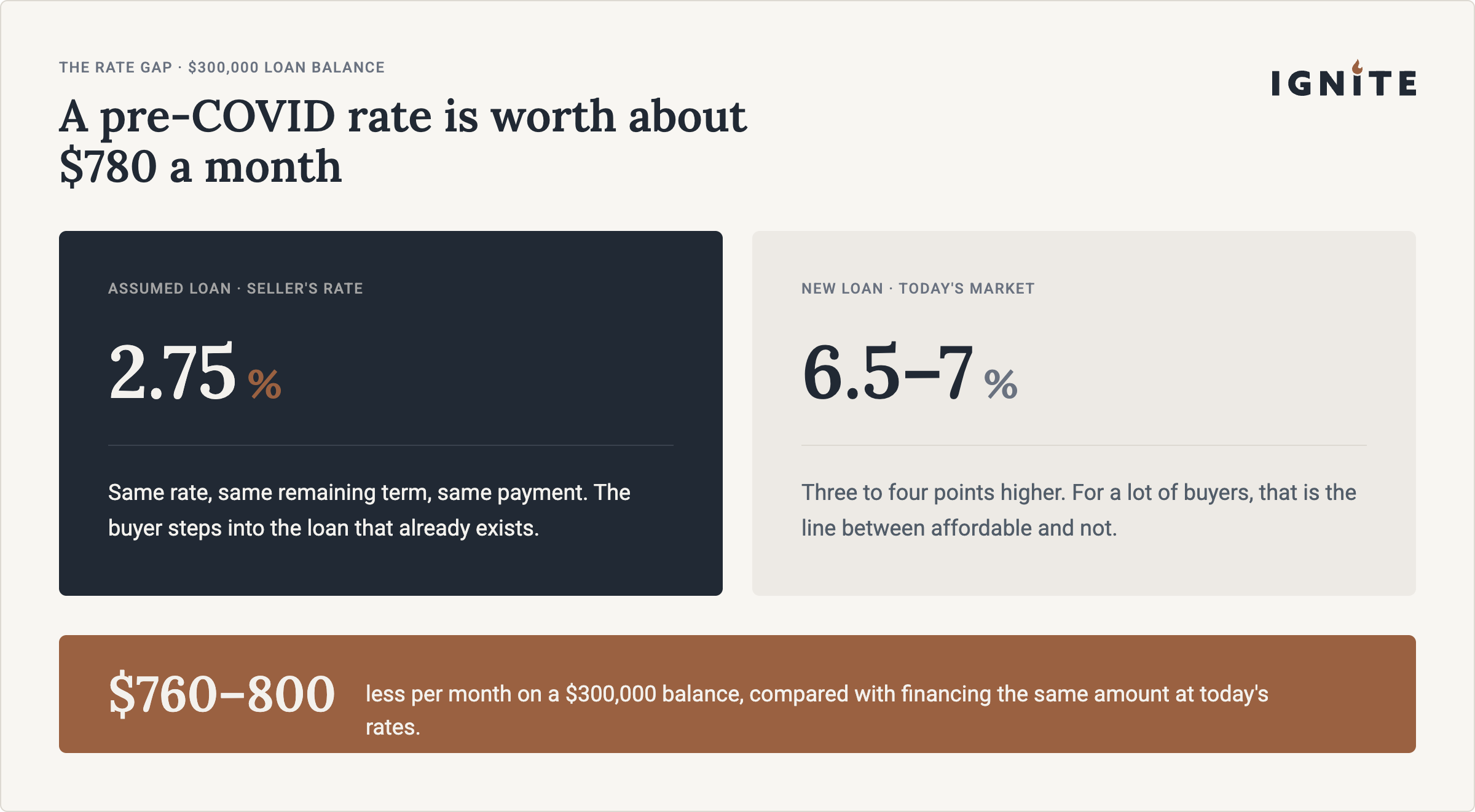
For the buyer, this is about as close to found money as it gets in a mortgage. They inherit your rate, which on a $300,000 balance could mean paying somewhere around $760 to $800 less a month than they would on that same amount at today's rates. No origination fees, no discount points, a fraction of the funding fee. Over a few years, that's real money staying in their pocket instead of going to interest.
For the seller, the win shows up in a different way — it shows up in your negotiating position. In a market where a 7% rate is scaring off buyers, a house that comes with a 2.75% loan attached is a house that stands out. You can reasonably expect more interest, a stronger offer, and in some cases a higher sale price, because you're handing the buyer something valuable that money alone can't easily buy anymore. We've had clients ask, "does that really move the needle?" And the honest answer is yes — when the gap between your old rate and today's rate is three or four points, that's not a nice-to-have, that's a headline feature of the house.
There's also a non-financial piece worth naming: for veterans specifically, keeping a VA loan attached to the property and passing it to another qualified veteran keeps that benefit working the way it was designed to. It's one of the few times "pay it forward" and "save real money" point in the exact same direction.
I'm not going to sugarcoat this one, because there are real trade-offs.
The process is slower and more paperwork-heavy than people expect, and it runs entirely on the servicer's timeline, not yours. If you're a seller who needs to close fast, this can be a deal-killer. The buyer still has to fully qualify — an assumption is not a way to sneak a shaky buyer into a house. And if a non-veteran buyer assumes your loan, your VA entitlement generally stays tied up with that property until the loan is paid off or refinanced, which can limit your ability to use a VA loan again down the road, unless the buyer is also a VA-eligible veteran willing to substitute their entitlement for yours. That's a conversation worth having with your lender and, frankly, with us, before you list the house.
Some servicers also just aren't set up to handle assumptions smoothly, and a slow one can turn a 60-day process into a 120-day one. Then there's the piece that trips up almost everybody, which gets its own section because it deserves one: what happens when the house is worth more than what's left on the loan.
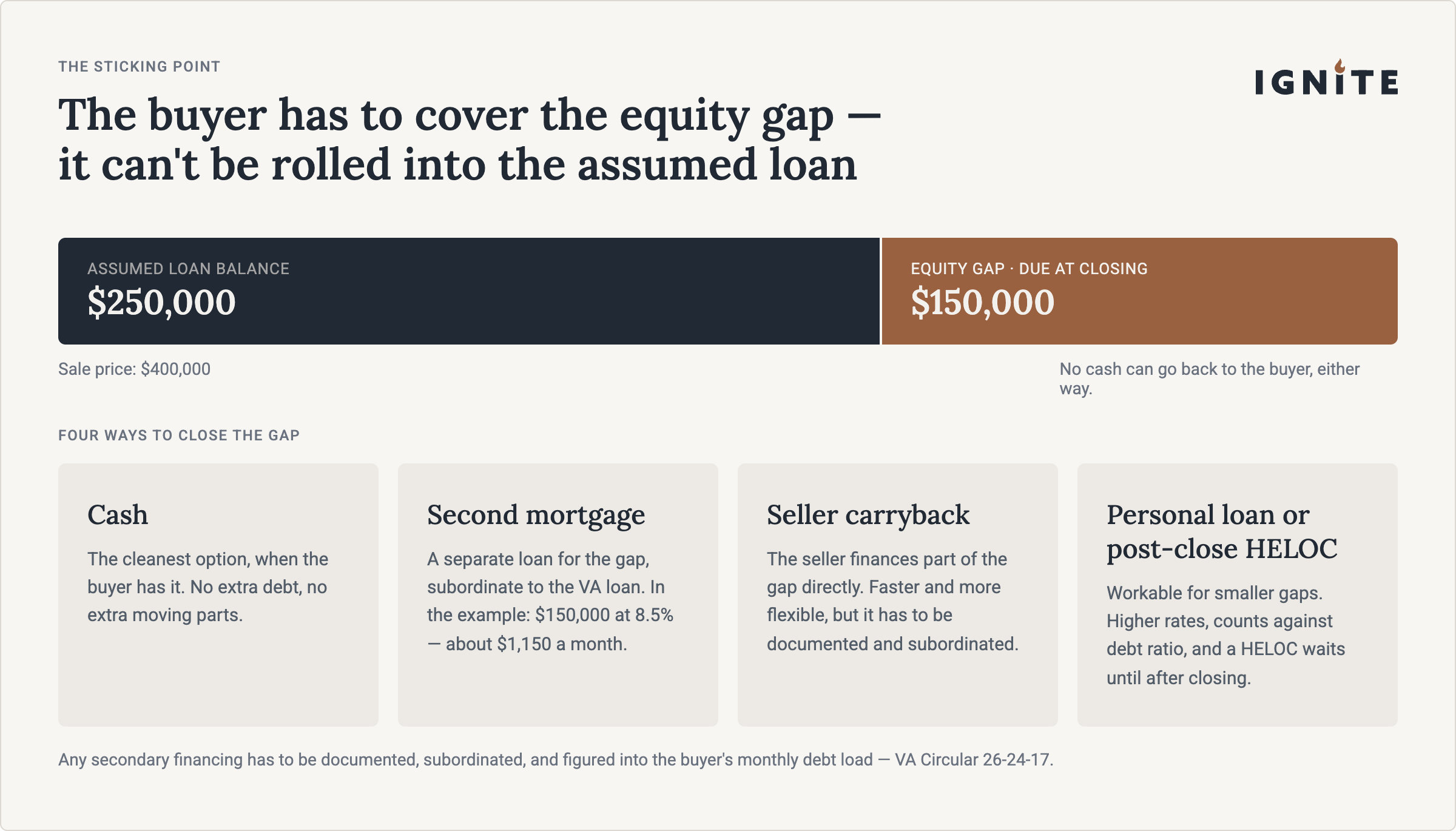
Here's the math that catches people off guard. Let's say you owe $250,000 on your VA loan. Your house, thanks to a few years of appreciation, is now worth $400,000. That $150,000 difference is your equity, and technically, the buyer has to come up with it — in cash — at closing, on top of assuming the loan. VA rules don't let a buyer roll that gap into the assumed loan itself, and no cash can go back to the buyer either way, so this has to be dealt with head-on rather than waved away.
Most buyers who could write a $150,000 check wouldn't need to assume a loan in the first place, so let's talk about the actual ways people close that gap.
Cash. The cleanest option, when the buyer has it. No extra debt, no extra moving parts.
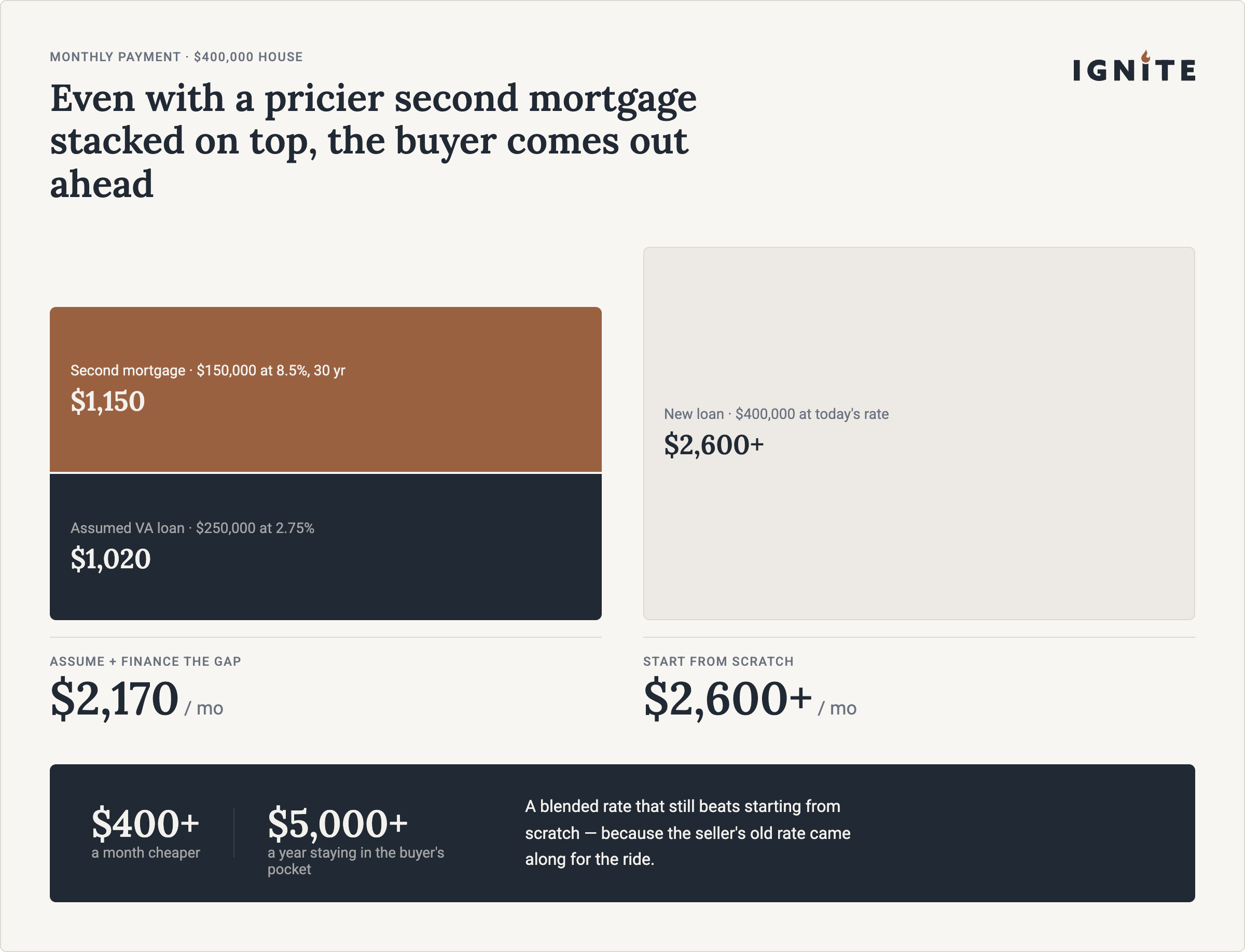
A second mortgage on top of the assumed loan. The buyer gets a separate loan — through a bank or credit union — just for the gap amount, subordinate to your VA loan. Say the $150,000 gap gets financed at a higher rate, something like 8.5%, over 30 years. That second payment runs around $1,150 a month. Add that to roughly $1,020 a month on the assumed $250,000 balance, and you land around $2,170 a month combined. Compare that to a brand new loan on the full $400,000 at today's rate, which could run $2,600 or more a month. Even with a pricier second mortgage stacked on top, the buyer's still coming out ahead — call it $400-plus a month. That's the whole trick: a blended rate that's still cheaper than starting from scratch.
Seller carryback. Instead of a bank, you as the seller finance part of the gap directly and the buyer pays you back over time, at terms you both agree to. This can close faster than a bank-originated second and gives you some flexibility on the interest rate, but it needs to be documented properly and subordinated to the VA loan — this is not a handshake and a Post-it note.
A personal loan or a post-close HELOC. Workable for smaller gaps, but personal loans carry higher rates and get counted against the buyer's debt ratio, and a HELOC generally can't happen until after closing, once the buyer actually owns the home and has equity to borrow against. Neither is usually the first choice, but they're tools in the kit for the right situation.
The VA has specific rules here too (Circular 26-24-17, if you want to look it up) — any secondary financing has to be documented, subordinated, and figured into the buyer's monthly debt load. This is exactly the kind of paperwork where a good lender who's actually done VA assumptions before, versus one who's never touched one, makes all the difference.
Add it up from the example above and the blended payment — assumed loan plus second mortgage — still lands over $400 a month cheaper than financing the whole thing fresh at today's rate. That's more than $5,000 a year staying in the buyer's pocket, just because the seller's old rate came along for the ride.
For the seller, that same math is a selling point you can put right in the listing: "assumable 2.75% VA loan." In a market where plenty of buyers are doing mental math on affordability, that line can be the difference between three showings and thirty. Any questions on how that would shake out with your specific numbers? That's exactly the kind of thing worth running before you list — or before you make an offer on a house that has one of these attached.
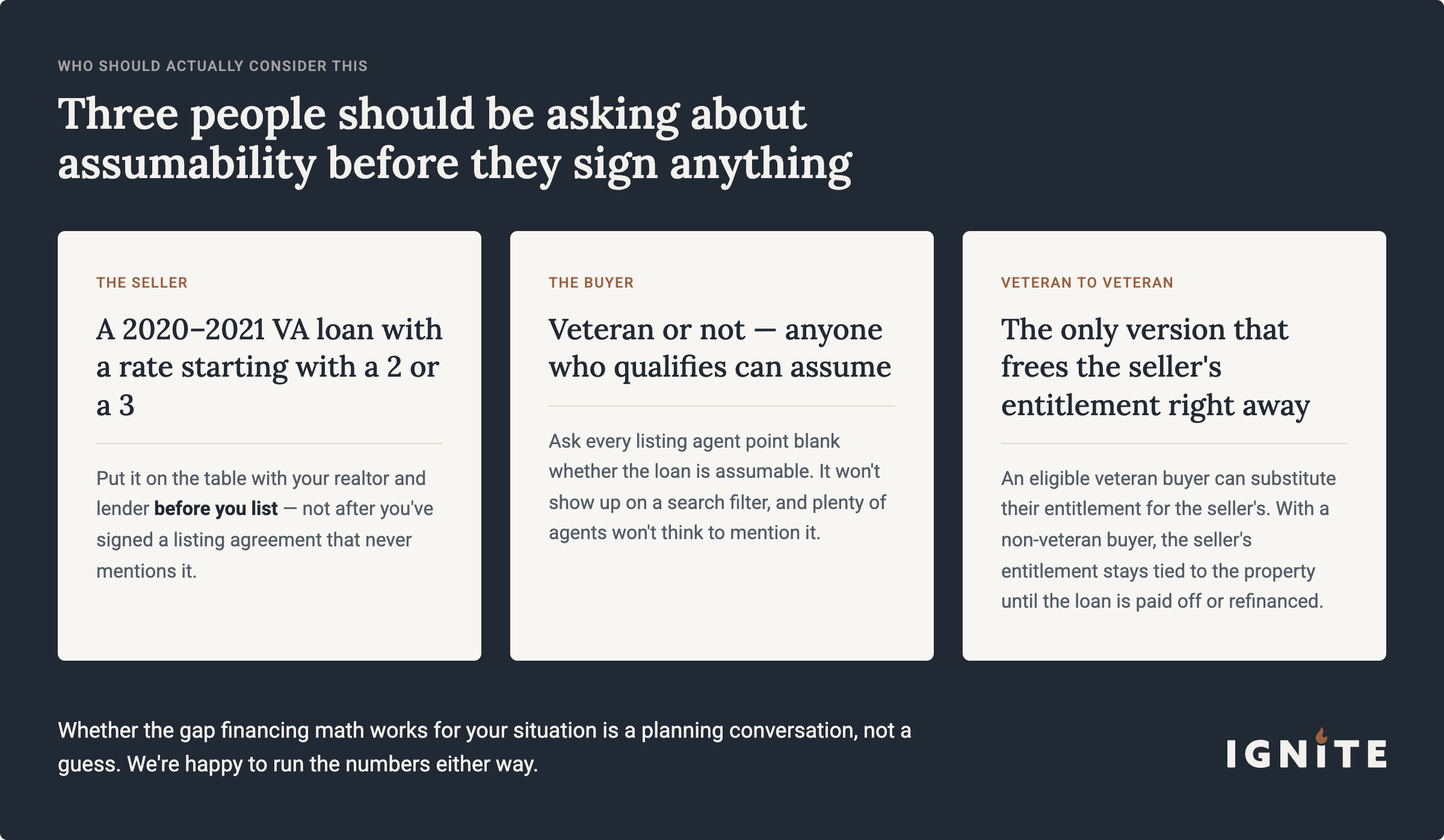
If you're a seller sitting on a VA loan from 2020 or 2021 with a rate that starts with a 2 or a 3, and you're thinking about selling in the next year or two, this is worth putting on the table with your realtor and your lender before you list — not after you've already signed a listing agreement that doesn't mention it.
If you're a buyer, especially a fellow veteran, ask every listing agent point blank whether the seller's loan is assumable. It won't show up on every search filter, and plenty of agents flat out won't know to mention it unless you ask.
And if you're weighing whether the gap financing math actually makes sense for your situation — whether a second mortgage, a seller carryback, or just saving up more cash first is the right lever to pull — that's a planning conversation, not a guess. We're happy to run the numbers with you either way.
Anyone can assume a VA loan, veteran or not, as long as they qualify with the servicer — credit, income, and debt-to-income like any other loan approval. Being a veteran only matters if the seller wants their VA entitlement freed up right away, which requires the buyer to also be an eligible veteran willing to substitute their entitlement for the seller's.
The buyer typically pays a VA funding fee of about 0.5% of the remaining loan balance, plus a servicer processing fee usually capped around $250 to $300, plus standard closing costs. That's meaningfully less than the funding fee and closing costs on a brand new VA loan.
VA rules call for 45 days, but in practice it often runs 45 to 120 days depending on the servicer. Plan for a longer close than a typical purchase.
The buyer has to cover that difference — VA rules don't allow it to be rolled into the assumed loan. Common ways to cover it are cash, a second mortgage/subordinate financing, or a seller carryback note, each properly documented and subordinated to the VA loan.
Not if a formal Release of Liability is obtained through the servicer as part of the assumption. Without it, the seller could remain on the hook if the new buyer defaults, so this step should never be skipped.
If a non-veteran buyer assumes the loan, the seller's entitlement tied to that property generally stays encumbered until the loan is paid off or refinanced. If the buyer is also an eligible veteran, they can substitute their entitlement for the seller's, freeing it up right away.
Whether you're a seller trying to figure out how to market an assumable loan, or a buyer trying to figure out if assuming one and covering the gap actually fits your budget, this is exactly the kind of decision worth running through a full plan before you sign anything. We're not a mortgage lender or a loan officer — but as your fee-only financial planner, we can help you run the real numbers and see how it fits your bigger financial picture.
Give us a holler through our contact page, or grab a time that works right here: schedule a free introduction meeting. Take care.
— Mike, Ignite Financial