


Roth conversions aren't right for everyone. CFP Mike Dunlop outlines 6 specific situations where converting your IRA could cost you more than it saves.

Scroll through any personal finance forum, watch a few YouTube videos, or ask a chatbot about retirement planning, and you'll get the same answer within about 30 seconds: convert to a Roth. Convert now. Convert aggressively. Convert before the tax cuts expire.
The logic behind that advice is real. In the right situation, a Roth conversion is one of the most powerful moves a pre-retiree can make. But the internet has taken a context-dependent strategy and turned it into a blanket prescription — and that prescription quietly backfires for a meaningful number of people.
This post is for anyone in the roughly 55-to-72 window who has a significant pre-tax balance and has been hearing “Roth conversion” from every corner of the internet. I'm going to walk through 6 specific situations where converting is the wrong move, or at least the wrong move right now.
Before we get to the list, I need to show you the single question that sits in front of all of it — because without it, the whole framework falls apart.
A Roth conversion is a bet. A specific, dollar-denominated bet that works like this: you pay tax today at your current rate, in exchange for never paying tax on that money again. The bet pays off when your future tax rate is higher than your rate today. It loses when it isn't.
So before any of these 6 reasons even matter, you have to answer one question honestly:
Is my tax rate in retirement realistically going to be higher than it is right now?
Not hypothetically. Not “the government might raise rates someday.” Your actual income picture — your actual bracket — your actual sources of cash flow when required minimum distributions start at age 73, or 75 if you were born in 1960 or later under the SECURE 2.0 Act.
If the answer is clearly yes, conversion probably makes sense. If the answer is no — or even maybe — converting just prepays a bill you would have paid at the same rate anyway. That's not a win. It's moving money around and writing a check to the IRS today instead of tomorrow.
Keep that bet in mind as you read through this list. Every one of these 6 reasons is a condition that either breaks the bet entirely or changes the odds enough that it stops making sense to pull the trigger.
This one gets skipped more often than any other, and it's the most straightforward: your tax bracket in retirement may be about the same as it is right now.
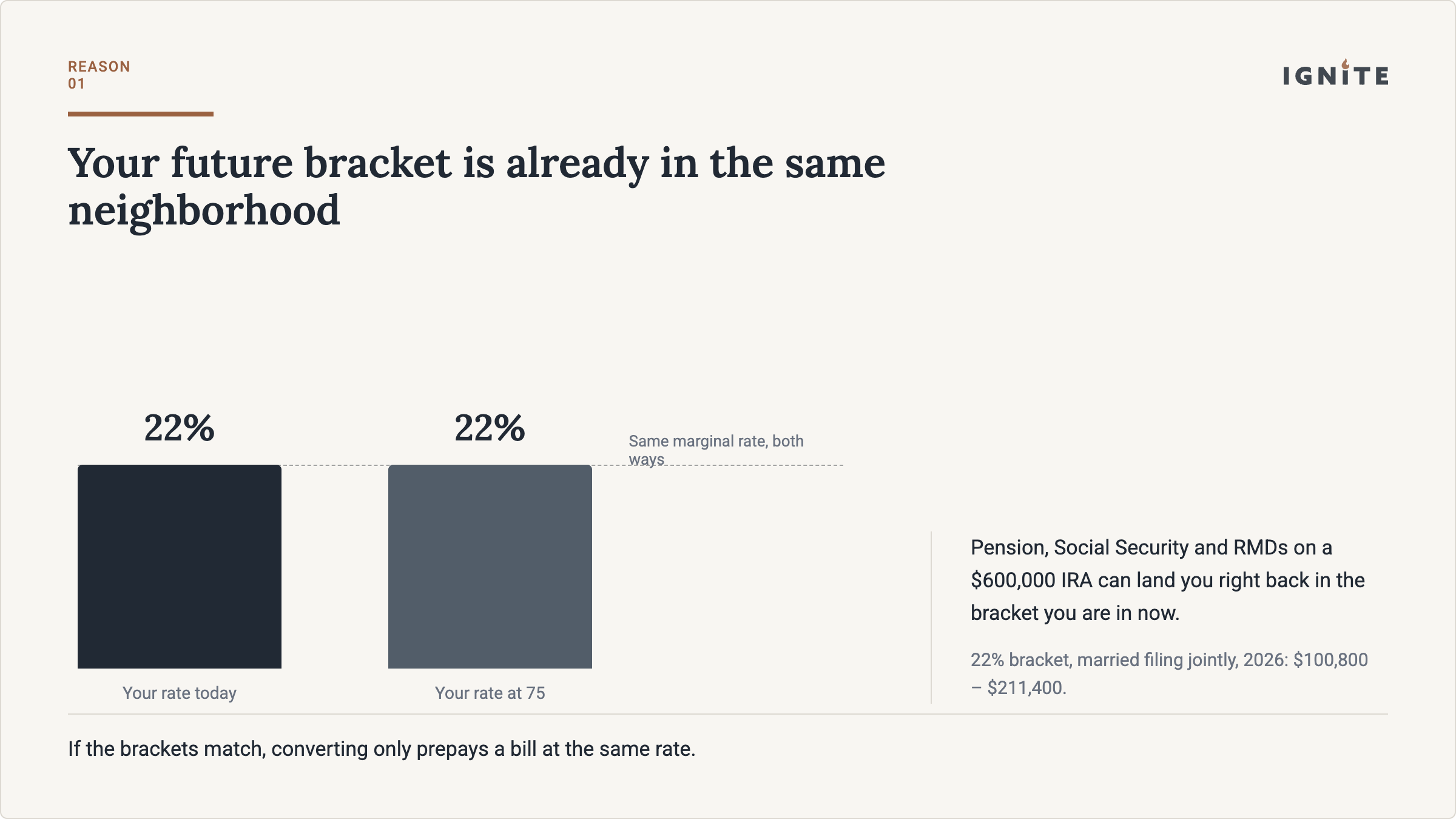
A lot of people assume retirement automatically means a lower tax bracket. Sometimes it does. But consider someone who retires at 65 with a pension, Social Security income, and a $600,000 IRA that starts generating required minimum distributions at 73. When you add those income streams together, the taxable income picture in retirement is often not dramatically different from the working years. In some cases, it's actually higher.
So let's say you're in the 22% federal bracket today. When we run your retirement income projection, it shows you landing in the 22% bracket at age 75, too. According to the IRS 2026 inflation adjustments, the 22% bracket for married filers begins at $100,800 in taxable income and runs to $211,400.
Converting today costs you 22 cents on every dollar moved. Deferring costs you 22 cents on every dollar pulled out later. The math is a wash — except that if you convert today, you write that check now with dollars you could have let compound inside the account instead.
The tax tail should not wag the dog. Before you convert a single dollar, run the projection. If the brackets match, the urgency disappears.
The second reason trips up a lot of people who are still working part-time, collecting a pension, or drawing Social Security while thinking about converting.
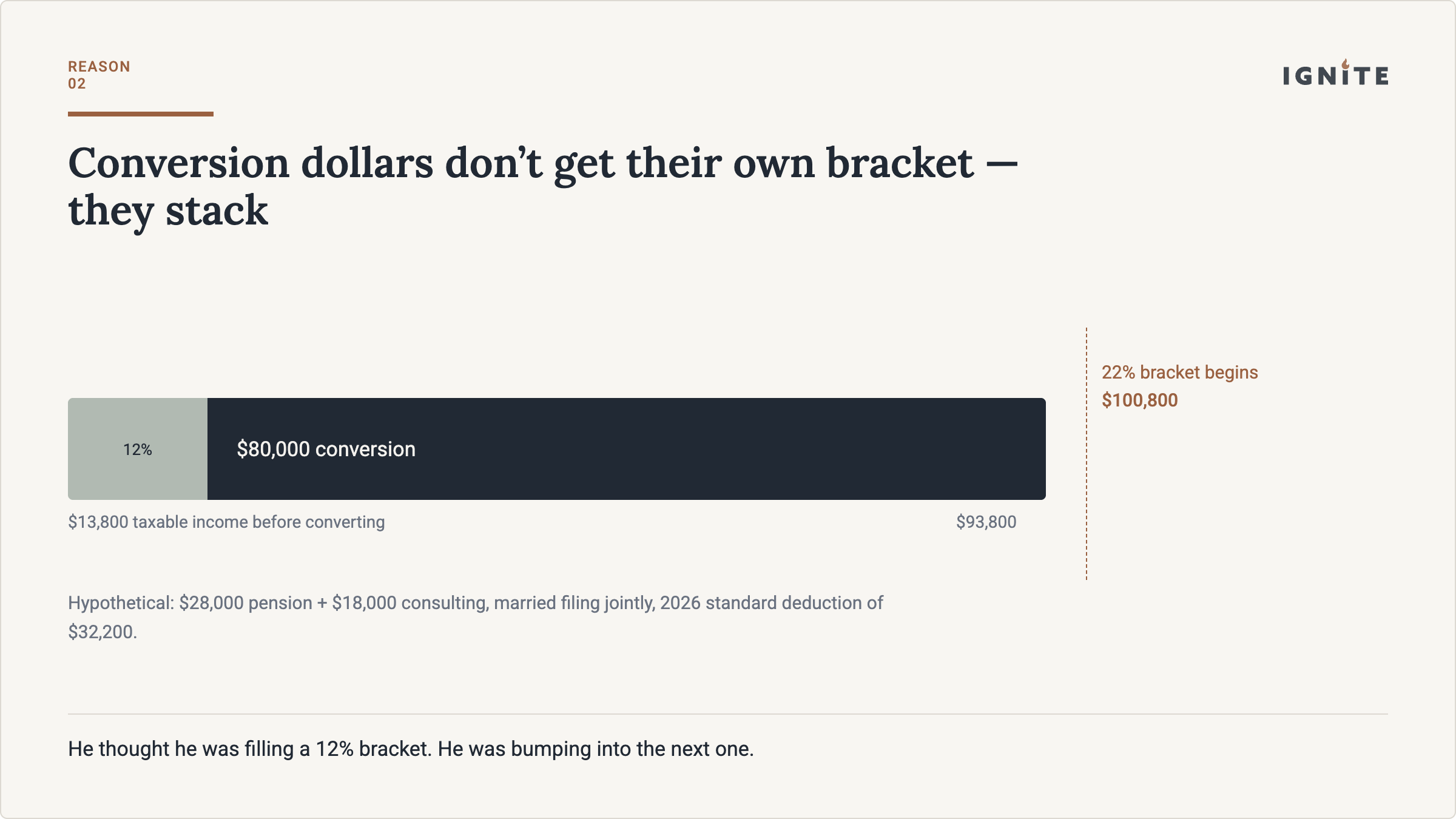
Here's what many people miss: conversion dollars don't get their own bracket. They stack on top of every other dollar of income you're already earning.
Consider this hypothetical scenario. Imagine a 64-year-old retiree — let's call him Jim — who receives a $28,000 annual pension and earns $18,000 a year from part-time consulting. He's married, and together with his wife they take the 2026 standard deduction of $32,200 for married filers jointly. That puts their taxable income at roughly $13,800 before any conversion — comfortably inside the 12% bracket.
Sounds like a great time to convert, right?
But Jim wants to move $80,000 from his traditional IRA. Stack that on top, and his taxable income jumps past $93,800. That's approaching the boundary of the 22% bracket for married filers in 2026, which begins at $100,800 — and a chunk of that conversion hits 22 cents on the dollar instead of the 12% rate he was counting on.
He assumed he was filling a low bracket. He was actually bumping into a higher one. (This is a hypothetical example for illustration purposes only.)
The math on a Roth conversion isn't just your conversion amount. It's your conversion amount plus every other dollar of taxable income you're carrying that year. If you're not running that full picture, you don't know your real rate.
This is what I call the stealth tax — and it catches even careful planners off guard.
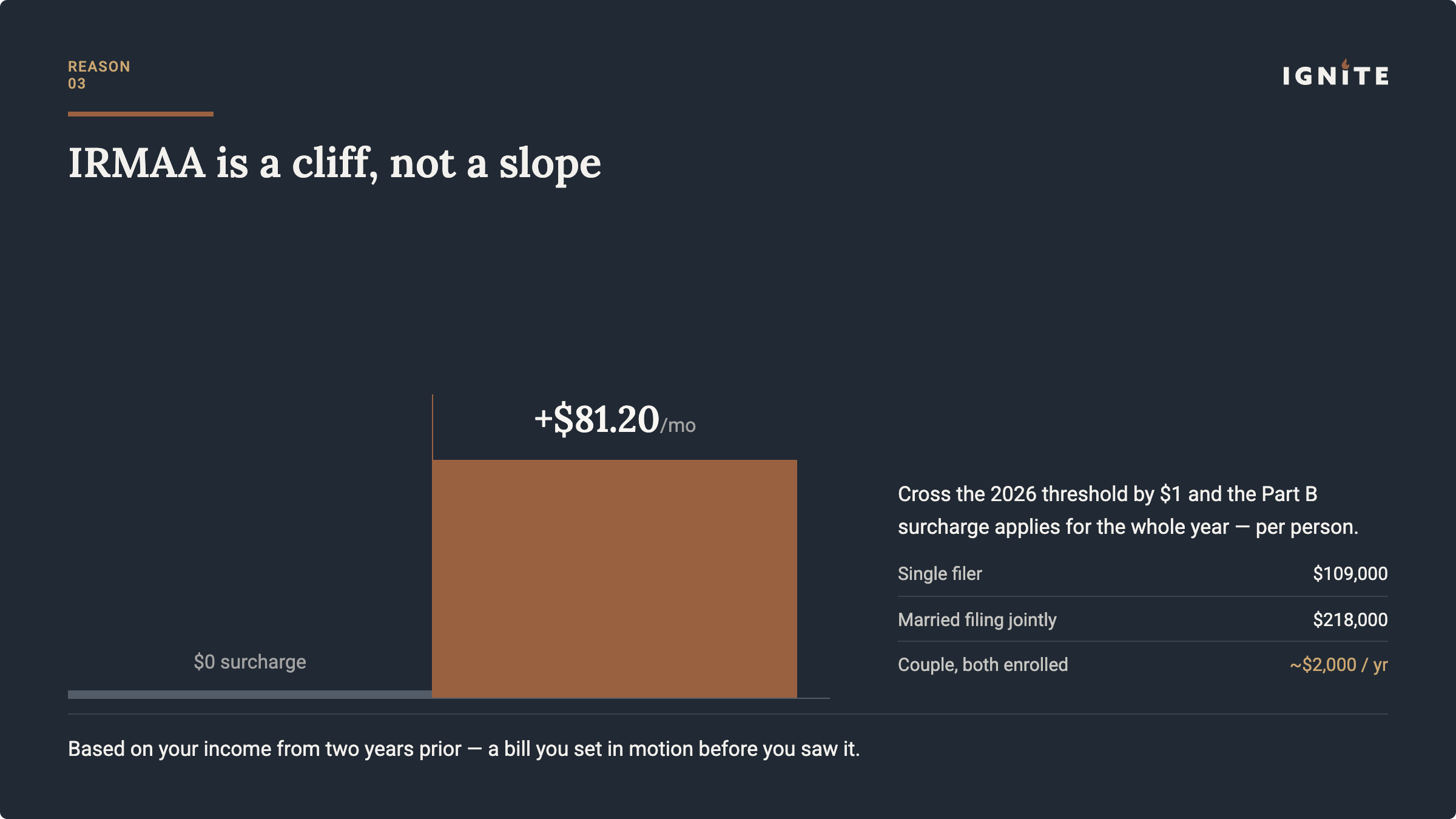
Medicare's Income-Related Monthly Adjustment Amount (IRMAA) adds a surcharge to your Part B and Part D premiums based on your income from two years prior. In 2026, the first trigger for that surcharge sits at $109,000 of modified adjusted gross income for a single filer, or $218,000 for a married couple filing jointly, according to the Centers for Medicare & Medicaid Services.
Here's the part that bites people: IRMAA isn't a gradual phase-in. It's a cliff. Cross that threshold by $1 and every dollar of your Medicare premium jumps.
For a single filer in 2026, crossing from below $109,000 into the next tier adds $81.20 per month in Part B surcharges alone, per person — that's nearly $1,000 a year in additional Medicare cost, triggered by a conversion decision you made two years earlier and probably didn't model with Medicare in mind.
For a married couple where both spouses are on Medicare, the surcharge applies to each of them. A conversion that crosses the $218,000 joint threshold could cost the household close to $2,000 in extra annual premiums. And that doesn't go away after one year — Medicare re-evaluates the following year based on the next tax year's income, too.
That is a real, recurring cost that has to go into the math before you decide how much to convert. I've seen well-intentioned conversions that made obvious sense on a simple bracket comparison completely fall apart once the IRMAA hit was included.
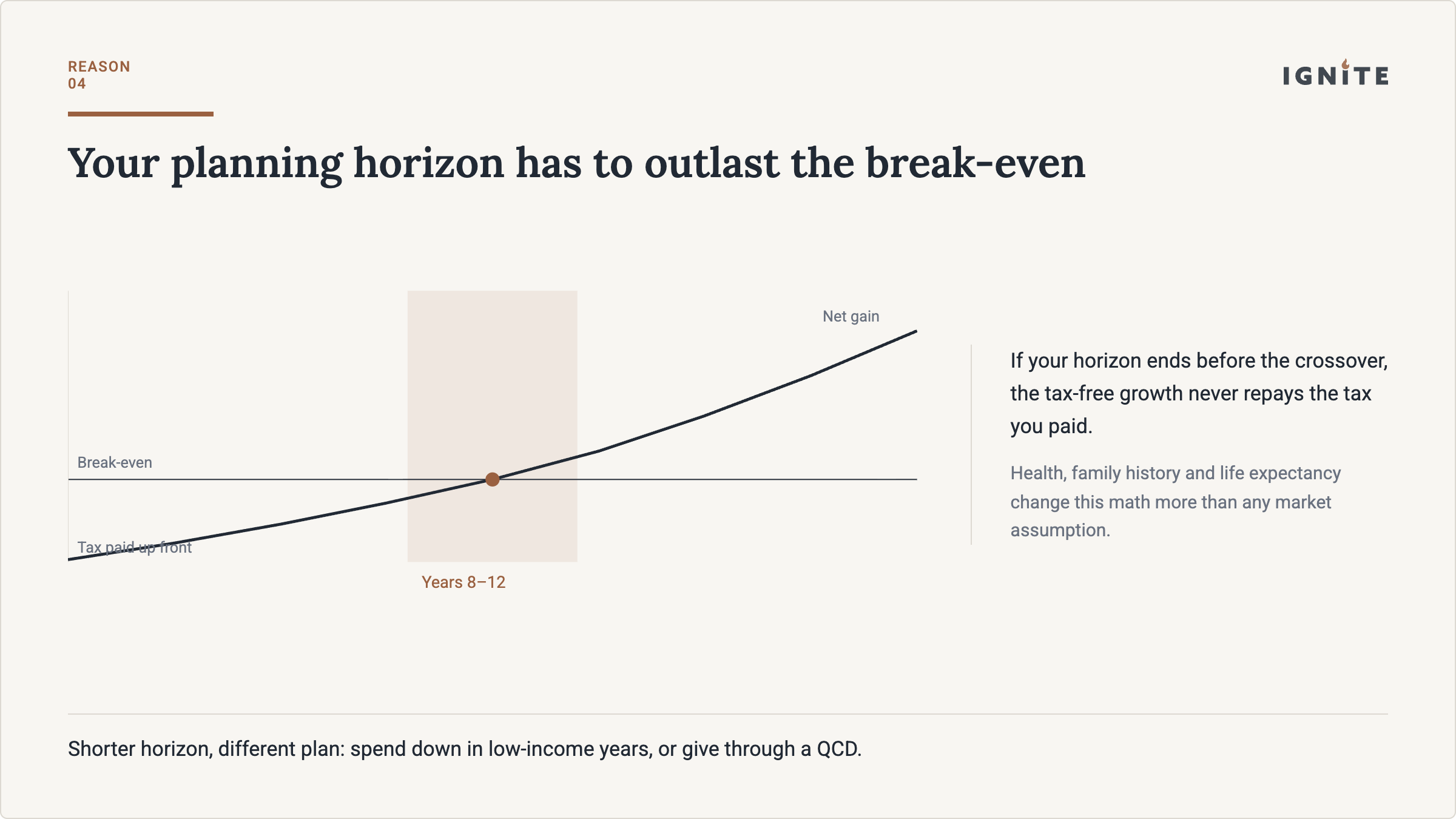
Remember the bet from the beginning? The Roth bet has a break-even point. You pay tax now, the money grows tax-free, and at some point the tax-free growth has repaid the upfront cost. That break-even generally lands somewhere in the 8-to-12-year range, depending on your assumptions — sometimes sooner, sometimes longer.
If your planning horizon is shorter than that break-even, the math never catches up.
And I want to say this plainly, because people don't always hear it said plainly: if your health is a real variable — if you have a condition, a family history, or a life expectancy that is meaningfully shorter than the population average — the Roth conversion math changes significantly. You might pay the tax, get five good years of tax-free growth, and never reach the crossover point where the conversion paid off.
That doesn't mean you don't plan carefully. It means the plan changes shape. In a shorter-horizon situation, keeping money in the traditional IRA and managing distributions thoughtfully — spending it down in a low-income year, directing some of it to charity through a Qualified Charitable Distribution — often beats a large conversion that requires paying a big tax bill for a benefit you won't live long enough to fully collect.
The right plan is built around your actual situation, not a general rule.
This one comes up more often than you'd expect once people start thinking seriously about legacy and giving.
If a portion of your traditional IRA is money you're planning to leave to a church, a foundation, or a cause you care about — converting that bucket to a Roth is almost always the wrong move.
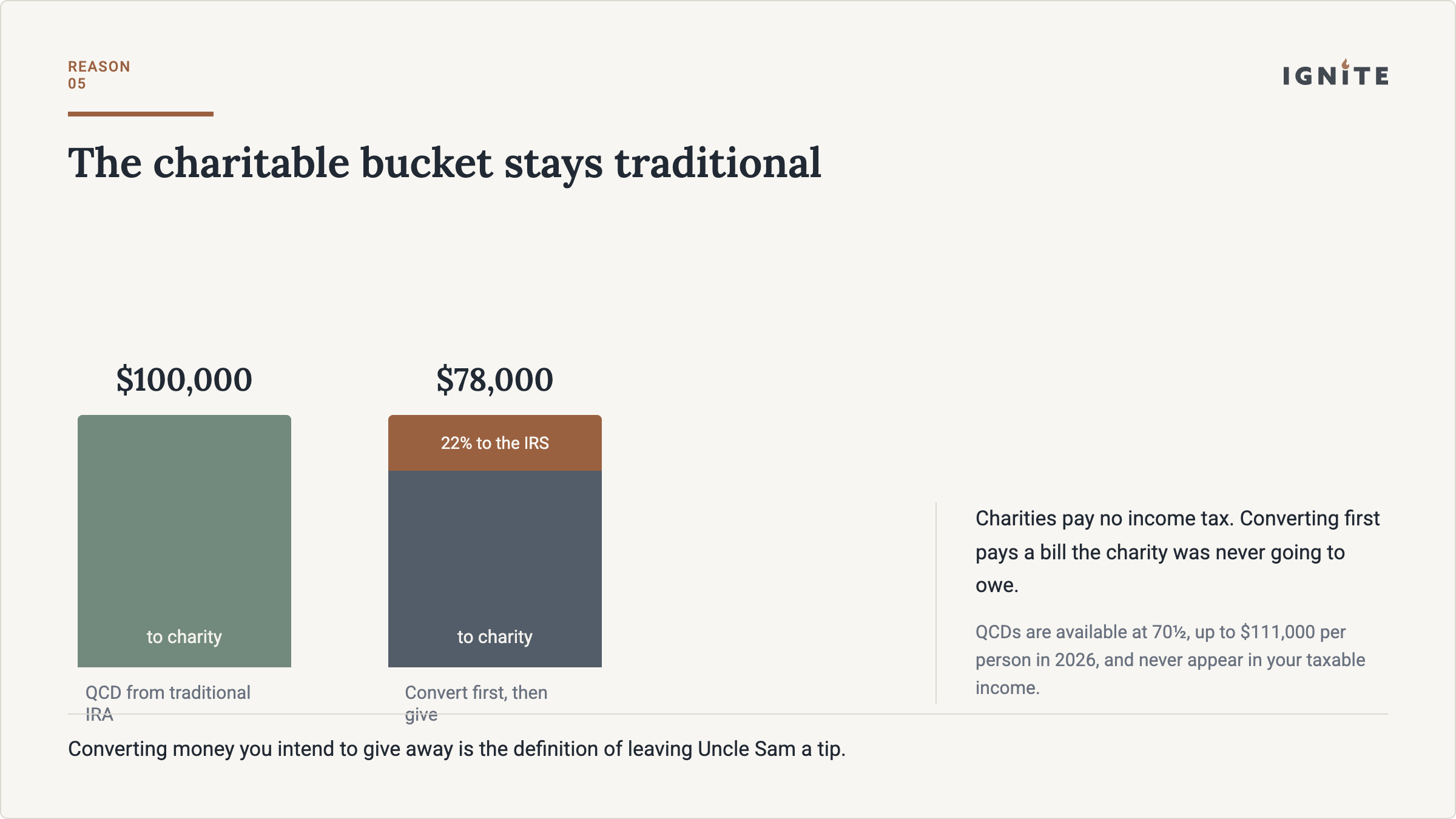
The reason is simple: charities don't pay income tax. When you leave a traditional IRA directly to a qualified charity, the charity receives the full value tax-free because they're exempt. The IRS never touches it. The “problem” of pre-tax money — that somebody eventually has to pay that deferred tax — simply doesn't exist when the recipient is tax-exempt.
Convert that same bucket to a Roth first, and you've paid ordinary income tax on every dollar, for a benefit the charity was going to get for free anyway. That is the definition of leaving Uncle Sam a tip.
The better tool for the charitable bucket is the Qualified Charitable Distribution (QCD). Once you're age 70½, the IRS allows you to send money directly from your traditional IRA to a qualified charity — up to $111,000 per person per year in 2026 — and that transfer never shows up in your taxable income. It satisfies your required minimum distribution and goes straight to the charity with zero tax taken out.
For any dollar you're planning to give away, a QCD out of a traditional IRA beats a Roth conversion every time. Charitable bucket stays traditional. That's the move.
This last reason is easy to overlook when the market has been calm and portfolios look healthy on paper.
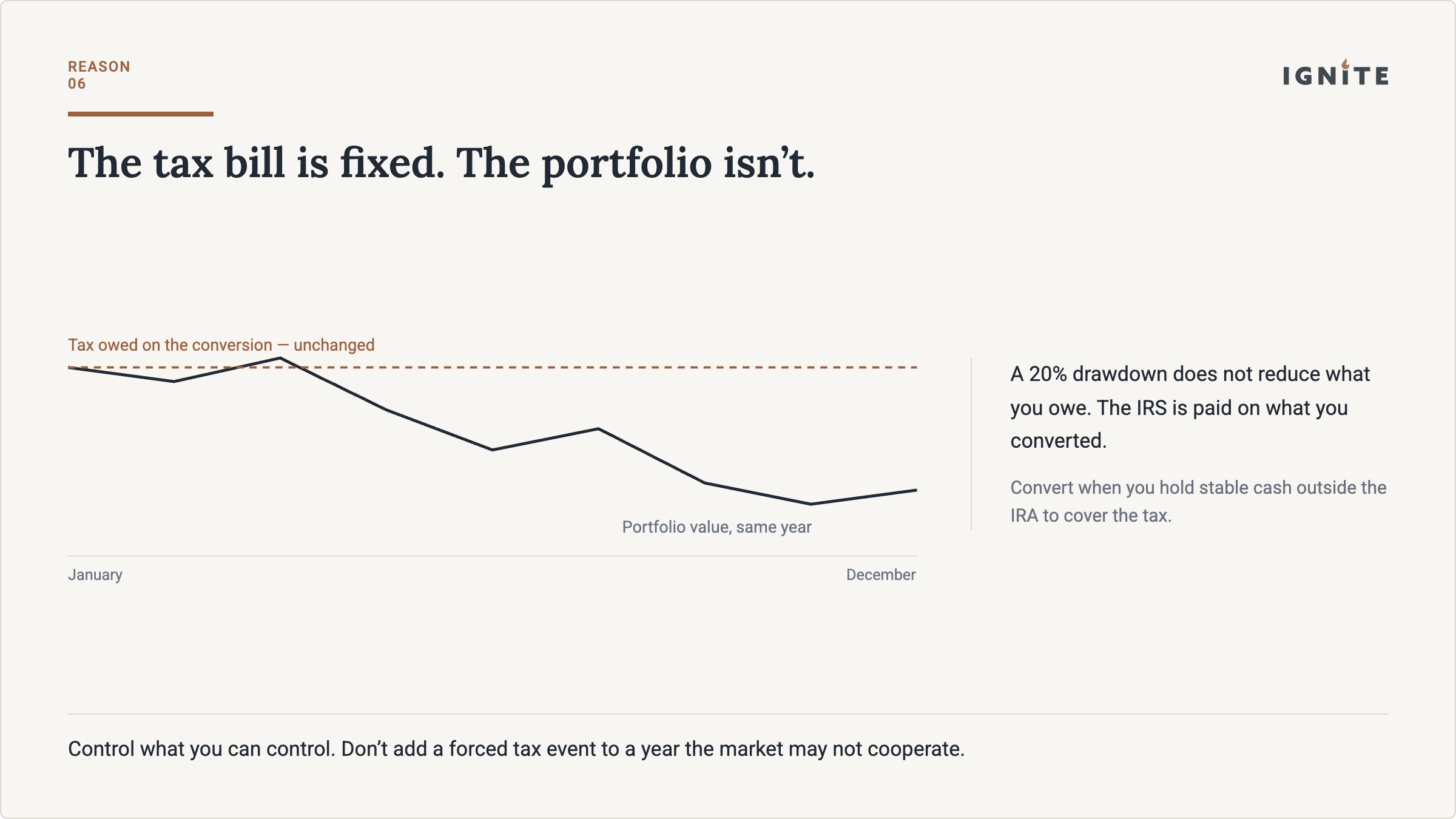
When you convert pre-tax money to a Roth, you owe income tax on that conversion amount in the year it happens. That tax bill is real and due — typically paid from cash or a taxable account, because paying it from the IRA itself defeats part of the purpose.
Now layer in a volatile portfolio. If your investments are concentrated in assets that can swing hard — and a lot of pre-retirees are still carrying equity-heavy allocations in their 60s — you're taking on two risks simultaneously. You're writing a large check to the IRS, and you're exposed to a potential market drawdown in the same year.
A 20% portfolio drop doesn't reduce your tax bill on the conversion. The IRS gets paid on what you converted, regardless of what the account is worth by December.
That combination — a large, locked-in tax obligation plus a portfolio that could drop in value — is a cash-flow risk worth naming out loud before you commit.
It doesn't mean you never convert. It means the right time to run a significant conversion is when you have stable, accessible cash to cover the tax without touching the IRA, and when your overall portfolio isn't sitting at a concentration risk that makes a bad sequence-of-returns year a real possibility.
Control what you can control. Don't add a forced tax event on top of a year the market might not cooperate.
Those are the 6 reasons to pump the brakes on a Roth conversion:
Any one of these can flip the math. More than one in the same year and it's not even close.
The Roth conversion is a genuinely powerful tool. But the internet's version — convert now, convert aggressively, don't ask questions — ignores the very real conditions under which it stops making sense.
The question is never “should I do a Roth conversion?” The question is always: does this specific strategy make sense for my specific numbers, my specific timeline, and my specific life?
That's the conversation worth having. If you want to go deeper on the other side of this, I wrote a companion piece on when a Roth conversion does make sense.
The clearest case is when your tax rate in retirement will be about the same as it is today, or lower. Converting then just prepays a bill at the same rate and hands the IRS money that could have kept compounding. The other common cases: the conversion would trigger an IRMAA surcharge, your planning horizon is shorter than the 8-to-12-year break-even, the money is already earmarked for charity, or you'd have to pay the tax bill out of a volatile portfolio.
Yes, and most people don't see it coming because the effect is delayed. Medicare's IRMAA surcharge is based on your modified adjusted gross income from two years prior, so a conversion in one year can raise your Part B and Part D premiums two years later. In 2026 the first threshold is $109,000 for a single filer and $218,000 for a married couple filing jointly, and it works as a cliff — one dollar over and the full surcharge applies for the whole year, per person.
Generally somewhere in the 8-to-12-year range, depending on your growth assumptions, the rate you pay on the conversion, and where the tax money comes from. Before that crossover, the tax-free growth hasn't yet repaid the tax you paid up front. If your planning horizon is shorter than the break-even — because of health, family history, or life expectancy — the math may never catch up, and a different strategy usually fits better.
For charitable dollars, essentially always. Charities are tax-exempt, so a traditional IRA left to a qualified charity passes without income tax ever being paid on it. Converting that same money first means paying ordinary income tax on every dollar for a benefit the charity was going to receive tax-free anyway. Starting at age 70½, a Qualified Charitable Distribution sends money straight from the IRA to the charity — up to $111,000 per person in 2026 — and it never appears in your taxable income.
No. Recharacterizing a Roth conversion was eliminated by the Tax Cuts and Jobs Act, so conversions completed in 2018 and later are permanent. This is a large part of why the decision deserves real analysis first — and why converting into a volatile year is risky. If the market drops after you convert, the tax bill stays exactly the same.
It can, because conversion dollars don't get a bracket of their own. They stack on top of every other dollar of taxable income you have that year — wages, pension, part-time consulting, taxable Social Security, interest and dividends. The only way to know your real rate on a conversion is to model the full income picture for the year, not the conversion amount in isolation.
If you want to see how these 6 reasons apply to your actual situation — your income, your bracket, your Medicare picture, your planning horizon — that's exactly the kind of conversation we have in an intro meeting at Ignite Financial.
No obligation. No sales pitch. Flat-fee and fee-only, so my advice is never influenced by commissions or a percentage of your nest egg.
Book your free intro meeting → and let's figure out whether converting makes sense for you — or whether there's a smarter move.
Michael Dunlop, CFP® is the founder of Ignite Financial in Cedar Falls, Iowa, and an Air Force veteran who built the firm on a simple premise: people deserve financial advice that is transparent, flat-fee, and completely free of sales incentives. Trained as an accountant, Mike brings a conservative, numbers-first approach to retirement planning — with a teacher's heart and a deep commitment to making sure clients understand every move in their plan. Ignite Financial serves individuals and couples approaching or living in retirement across Iowa and beyond.
This content is for informational purposes only and should not be considered investment, tax, or legal advice. Past performance is not indicative of future results. All investments involve risk, including possible loss of principal. The hypothetical scenarios presented in this post, including “Jim's” situation, are for illustrative purposes only and do not represent actual clients or outcomes. Tax figures, brackets, IRMAA thresholds, and QCD limits referenced are for tax year 2026 and are subject to change. Please consult a qualified tax or financial professional before making any financial decisions. Ignite Financial is a registered investment adviser in the State of Iowa. Registration does not imply a certain level of skill or training.